Clothing is the most public thing a culture makes. Long before a stranger hears the language or tastes the food, they see how a people dress, and in the Uyghur case what they see is unmistakable: a shimmering, rippling silk in colors that seem to argue with one another, and a small embroidered cap that no two towns wear quite the same way. Uyghur dress is not a costume kept for festivals. It is a daily language of color and pattern in which a person announces, without a word, where they come from, whether they are married, and how they wish to be seen. This essay reads that language: the cloth, the cap, the robe, and what has happened to all three under pressure.
The Cloth: Atlas Silk
At the heart of Uyghur dress is a single legendary fabric. Atlas silk, called etles in Uyghur, is a hand-dyed ikat woven above all in Hotan and the oasis towns of the southern rim, where mulberry trees and silkworms have been cultivated for well over a thousand years. Its distinctive look comes from the technique: the warp threads are tied off in bundles and dyed before weaving, so that the pattern is soaked into the yarn itself rather than printed on the finished cloth. Where the dye bleeds slightly past its intended edge, it leaves a soft halo, and it is this blur, these feathered borders of crimson into gold into indigo, that gives atlas its liquid, flame-like shimmer. The craft was recognized in 2008 as part of China's national intangible cultural heritage, a status that has not protected the culture that produced it.
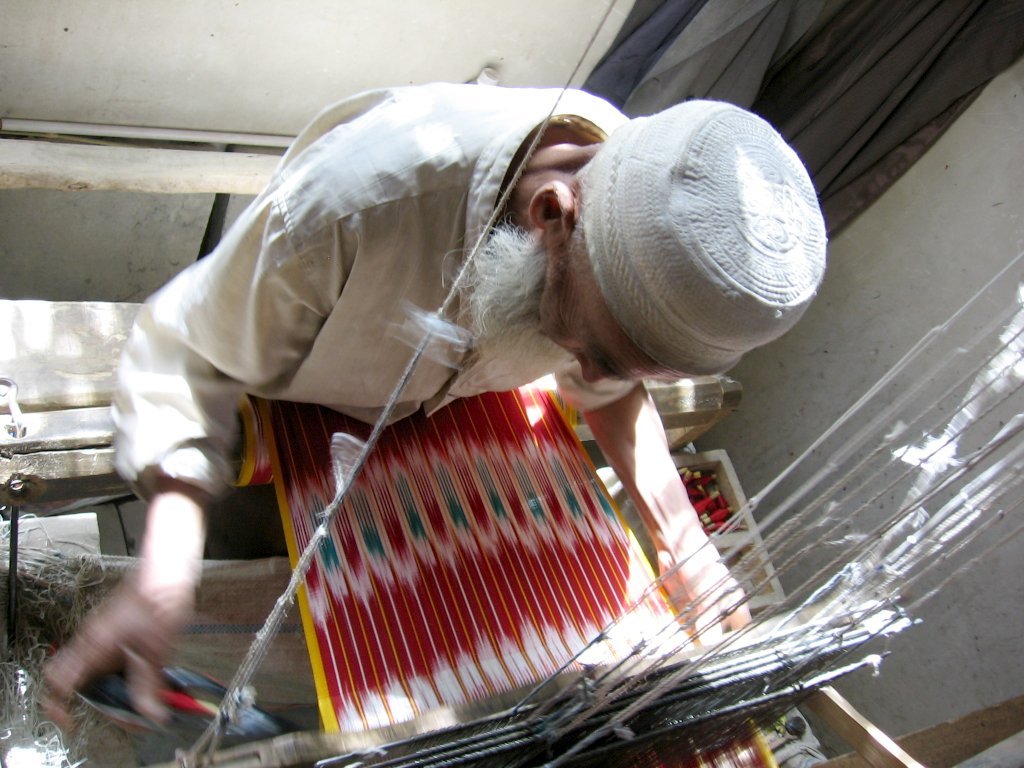
Atlas is not one cloth but a family, and the family has a grammar. Tradition distinguishes several types by color and wearer: a deep, sober qara-atlas for older women, brighter yellows, blues, and purples for married women, and a vivid qizil-atlas, red shot through with white and green, for young girls and brides. The most prized of all is the Yarkent or khan-atlas, the royal pattern once reserved for the court of the Yarkand khans. A Uyghur woman in a full atlas dress, billowing from a fitted bodice, is wearing a small map of her life: her age, her status, and her taste, all legible to anyone who knows how to look.
The Cap: The Doppa
If atlas is worn mostly by women, the cap belongs to everyone. The doppa is the small four-sided or rounded skullcap worn by Uyghur men, women, and children alike, and it is the single most recognizable marker of Uyghur identity. Most are made of dark velvet, black or deep green, and covered in dense embroidery worked by hand, a single fine cap taking a skilled embroiderer the better part of two weeks. The most classic design is the badam, the almond, a teardrop paisley named for the nut that grows across the region and repeated in white thread at the four corners of the crown.

The doppa is also a geography lesson. Each oasis embroiders its own way, and a practiced eye can place a wearer at a glance: the bold, radiant caps of Kashgar, the delicate floral work of Hotan, the plain rounded elegance of the Ili valley, the fiery almond patterns of Turpan. To put on a doppa is to declare not only that you are Uyghur but where in the Uyghur world you belong, which is why, in exile, the cap has become a rallying point. Diaspora communities now hold an annual Doppa Day, wearing the cap in public across a dozen countries as a quiet, wearable act of belonging.
Robes, Dresses, and Adornment
Around the cloth and the cap sits a whole wardrobe. In colder months a man traditionally wears the chapan, a long quilted coat descended from the caftans of Central Asia, wrapped and held not with buttons but with a sash tied at the waist. Women pair the atlas dress with trousers beneath, a practical inheritance from a mobile, horse-riding past, and cover their hair with a scarf. Both men and women favor soft leather boots, often worn with overshoes that can be slipped off at the door or at the threshold of a mosque. And Uyghur women have long loved ornament: heavy silver and coral jewelry, earrings and bangles and pendants, set against the deep colors of the silk. The whole ensemble reflects the region's position at a crossroads, Persian and Turkic and Islamic influences braided together into something particular to the oases and to nowhere else.
None of this is frozen. Uyghur dress absorbed the twentieth century as readily as any other, mixing the doppa with a Western jacket, the atlas skirt with modern shoes. A living tradition is one that changes on its own terms, and until recently that is exactly what Uyghur dress was.
Dress Under Pressure
Clothing that speaks so plainly of identity and faith was never going to escape a campaign aimed at both. Over the 2010s, the authorities increasingly treated certain garments as evidence of extremism. In 2017 the regional government issued rules that, among much else, banned full-face veils, robes covering the whole body, and “abnormal” beards across the region. Earlier local measures had already barred women in veils and men with long beards from boarding buses in some cities. Dress had become a checkpoint.
What makes the campaign against Uyghur clothing distinctive is its two-sidedness. Alongside the bans came a state effort, launched years earlier under the name Project Beauty, to promote a sanctioned version of Uyghur femininity: bright atlas silk, the embroidered doppa, uncovered braided hair, all held up as the “modern,” acceptable face of the culture, precisely as the veil was pushed out of public life. Uyghur dress, in other words, was not simply forbidden. It was split in two, the folkloric parts showcased on festival stages and tourist brochures, the religious parts criminalized, and the living whole from which both came steadily hollowed out. A culture is easiest to manage once it has been turned into a costume.
And yet the thread holds. In Istanbul and Almaty, in Munich and Amsterdam, Uyghur women still sew atlas dresses for their daughters and wedding guests still arrive in silk; the doppa is worn to protests and prayer and Doppa Day alike. Cloth is portable, and memory is stubborn. As long as a grandmother somewhere is teaching a granddaughter which corner of the cap takes the almond, the language of Uyghur dress is still being spoken. What that culture faces at home is the subject of the essays that follow.